Someone who has known you for years says, “I know you better than anyone.”
And a small, quiet part of you thinks:
you know the surface better than anyone.
It’s not that they’re wrong.
It’s not that you’ve been pretending.
It’s not that there’s a hidden version of you waiting to replace the one they know.
It’s simply that what they’ve spent years learning is the outermost layer — the part of you that faces the world. Beneath it, there are others. And most people, including sometimes you, never see how the whole structure is arranged.
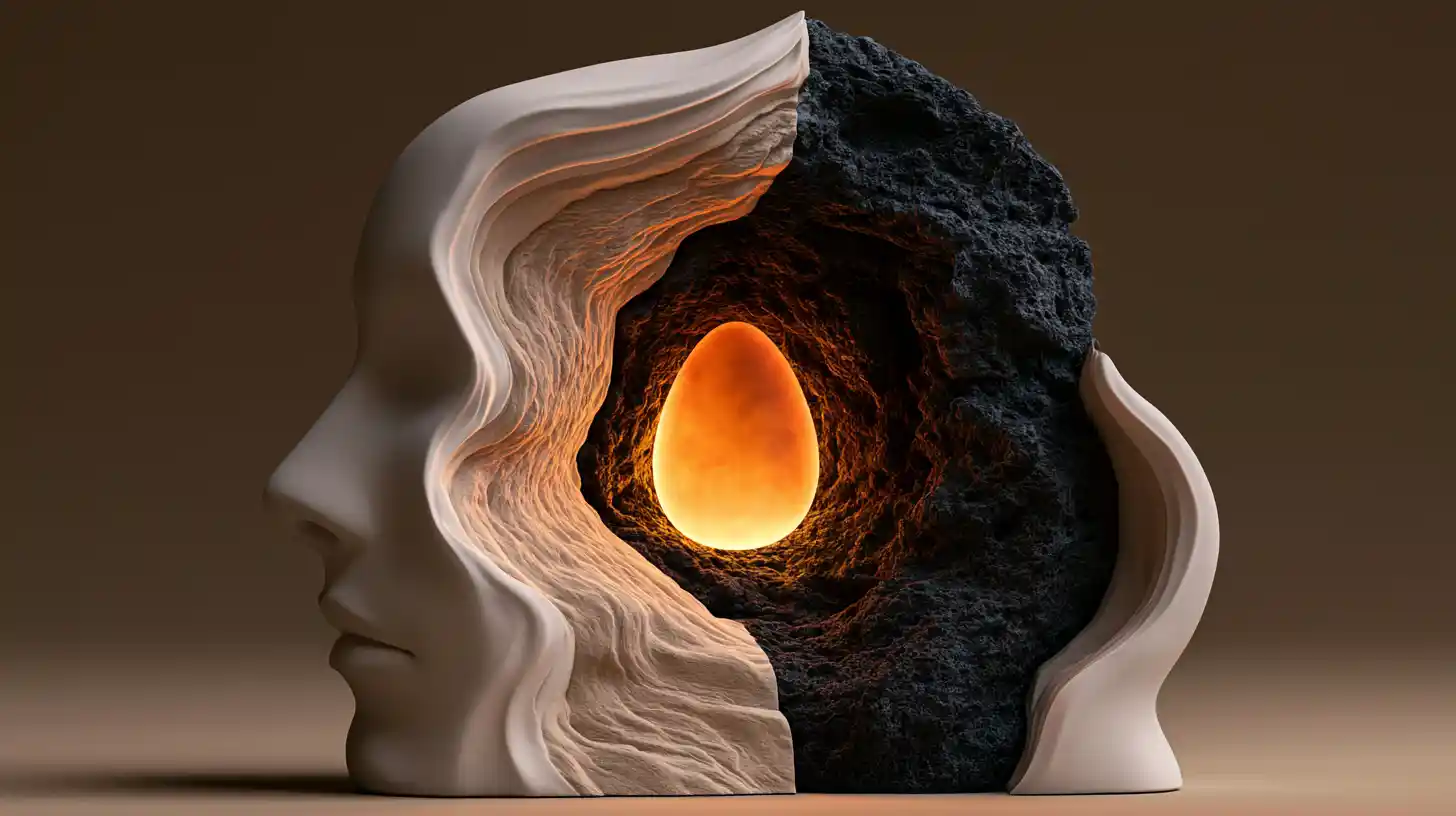
Imagine a cross-section of a building. Not the façade, not the windows, not the polished exterior people walk past — the cut-through. The view that shows every floor at once: what’s visible, what carries weight, what’s tucked in the middle, and what sits at the center holding everything together.
You have a cross-section too.
You’ve just never been shown it.
The Layer Everyone Meets
The outer layer is the one people encounter first.
Composed, capable, warm.
Quiet, sharp, steady, intense.
Open, distant, helpful, precise.
Depending on how you’re built, this layer can look a hundred different ways.
It’s easy to assume it’s a mask.
Usually, it isn’t.
It’s an outer structure doing real work: giving the world one readable version of you while the fuller, less settled version moves behind it.
Some people look calm while everything underneath runs hot.
Some look warm while their quiet lives deeper in.
Some seem easygoing while an inner order works nonstop.
Some seem strong because the vulnerable layer has learned to stay out of sight.
What people meet isn’t false.
It’s simply not the whole building.
This is why someone can know you for years and still, in some way, miss you.
They’re not careless — they’re reading the only layer they can see and mistaking it for the whole structure.
What people meet is your surface.
Where more of you lives is several floors down.
The Layers Underneath
One level in, you reach the part of yourself you know:
your thoughts, your explanations, your internal commentary — the version that would answer if someone asked, “Why did you do that?”
This layer tries to make your life coherent.
It gives reasons, builds a story, connects your reactions to something understandable.
But beneath it lies another layer.
Quieter.
Less formed.
It holds what hasn’t taken shape yet: feelings without words, reactions you carry for days, decisions half-made, pressure that returns until something in your life finally gives it form.
Most people never see this layer in you.
Sometimes you barely see it yourself.
This is the layer most often misread from the outside.
Someone who stays calm under pressure gets read as feeling less.
Someone who waits before responding gets read as hesitant.
Someone who goes quiet gets read as absent.
Someone who needs time gets read as unsure.
Usually, none of that is true.
You’re not feeling less.
You’re not stalling.
You’re holding something until it’s ready.
That holding, processing, waiting — it isn’t coldness or weakness or indecision.
It’s an entire layer doing its work out of sight.
The Tension That Runs Through You
Here is the part that explains the most.
Almost everyone has one central tension — two real forces pulling in opposite directions at the same time.
Holding on vs. letting go.
Control vs. expression.
Staying close vs. keeping distance.
Acting now vs. waiting for certainty.
Being useful vs. needing to stop.
Being seen vs. staying protected.
From the inside, this can feel like a flaw — a contradiction you’re supposed to resolve, a pattern you should have outgrown, proof that something in you isn’t simple enough.
But often, this tension isn’t an error.
It’s an axis — the line your important decisions turn on.
The same pull shows up in how you handle conflict, how you love, how you work, how you wait, how you enter a room and how you leave one.
Once you can name it, a hundred separate struggles begin to look like the same one wearing different clothes.
Your contradictions aren’t always a mistake in the design.
A lot of the time, they are the design.
The Core — and What It’s Actually Doing
At the very center, people expect to find a “real self” — some pure, final version, some untouched truth waiting to be uncovered.
But the core is usually less sentimental than that.
It’s more like a mechanism: a consistent way your whole system takes something in, works it through, and reaches resolution.
Some people move fast and decide early.
Some can’t settle until the pieces line up.
Some think out loud.
Some find the answer in silence.
Some need to act before they understand.
Some need to understand before they act.
Some turn pressure into usefulness.
Some hold pressure until it becomes precision.
Different cores, same job:
turning raw experience into something you can move from.
This core doesn’t change much from one situation to another.
It was running before you had language for it, and it’s running now — beneath the roles, beneath the tension, beneath the layer everyone meets.
It’s the part that makes you recognizable to yourself, even as your life changes around you.
Give that configuration a name, and you finally see it from the outside.
Not a label that boxes you in — a description of how you’re built.
Why Seeing the Structure Changes Everything
None of this is here to be fixed.
You can’t remove a layer and remain whole.
You can’t erase the central tension without erasing something that has shaped you for years.
You can’t reduce yourself to one trait and expect the rest to disappear.
The point isn’t to flatten yourself.
The point is to see the cross-section.
Because something shifts the moment you do.
What you’ve been quietly carrying stops looking like a problem and starts looking like a layer with a function.
The contradiction you’ve fought for years turns out to be the axis you were built around.
The reactions that felt random begin to reveal the structure they were always coming from.
That’s what this kind of map gives you:
the layer carrying the most pressure,
the tension your decisions turn on,
the mechanism at your core,
the shape they form together,
and the name of the configuration you’ve been living inside.
Not a personality type.
Not a list of surface traits.
A drawing of how you’re actually organized.
You were never acting randomly.
You were following a structure no one had shown you.
The only question is whether you can finally see it drawn.