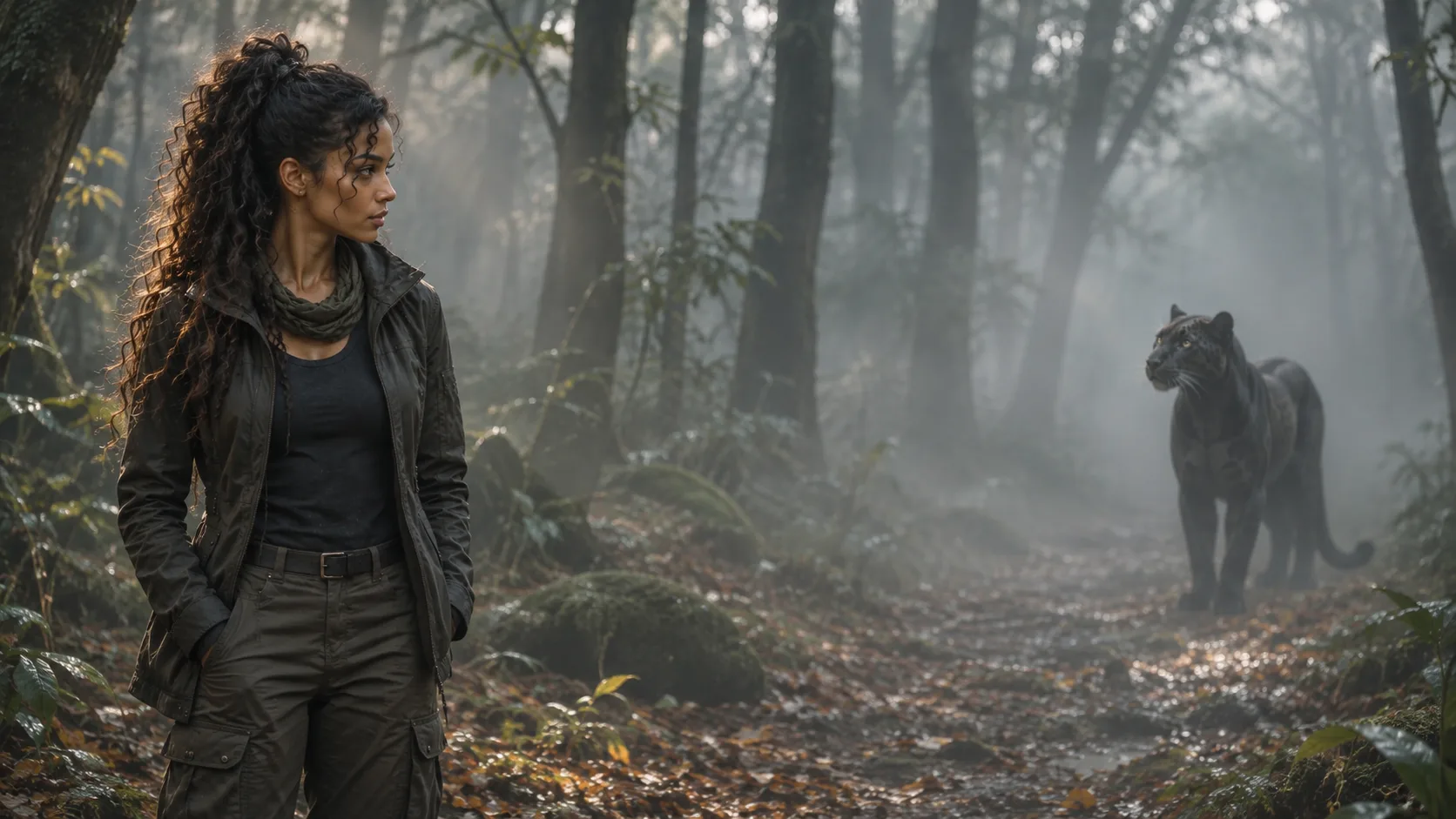
An animal can represent you because it carries a whole cluster of qualities in a single image — patience, vigilance, independence, belonging — the way a list of adjectives never quite does. But the meaning does not live inside the animal. It comes from culture, from your own experience, and from what you are looking for. The more interesting question may not be which animal you are, but why a particular animal feels like you.
The heron under the bridge
It is early morning. A train is approaching in the distance.
Below the bridge, at the edge of a narrow strip of water, a heron stands perfectly still. You have passed this place hundreds of times. Today, for some reason, you stop.
Everything around it is hurried — cars, footsteps, the approaching train. The bird does not move. You find yourself thinking: I wish I could be like that. Unhurried. Certain. Comfortable waiting.
Someone beside you might see something else: solitude, distance, a creature that never quite joins the others. And someone who knows herons well would simply see a bird waiting to catch a fish.
Same animal. Three different meanings.
You have not discovered the heron's personality. You have noticed what its image means to you. That is where the interesting part begins.
Why animals become mirrors
They compress character. Say fox and you have said clever, watchful, a little untrustworthy. Say bear and you have said strength, warmth, danger when disturbed. One image carries what would take a paragraph to describe.
The bridge runs both ways. People readily attribute human feelings, intentions and personalities to animals — a tendency psychologists call anthropomorphism (Epley, Waytz & Cacioppo, 2007). Describing people through animals is the reverse movement, sometimes called zoomorphism, and everyday language is full of it: stubborn as a mule, busy as a bee, gentle as a lamb. Research on anthropomorphism doesn't explain why you identify with one particular animal. But it helps explain why the traffic of meaning between humans and animals feels so natural.
We have done it for a very long time. Fables give animals our virtues and our failings. Coats of arms put lions and eagles on shields. Children's stories, political cartoons and fictional worlds still do the same.
Animals carry contradictions. A wolf is loyal to its pack and dangerous to outsiders. A swan is graceful on the surface and paddling hard underneath. That doubleness is what makes animal images feel true — people are rarely just one thing either. It is also why a single animal is rarely enough, the idea behind What Animal Are You? Meet The Animals Within.
But it is worth remembering: a fox does not exist to represent human cleverness. An owl is not wise to itself. Those meanings belong to our language and imagination — not to the animal, and not, automatically, to you.
The same animal can mean different things
Animal symbols have no universal meaning. A snake can stand for danger, healing or renewal. A raven can be ominous in one story and resourceful in another.
Even ordinary animal words shift between languages. In a study with informants from 38 regions, common words such as cat, cow and mouse turned out to carry a wide range of figurative meanings — and people tended to read them through the associations of their own first culture (Nesi, 1995).
Personal experience shapes meaning too. Someone who grew up around horses may associate them with trust and careful communication. Someone who knows horses only from films may associate them with freedom.
So treat any universal "animal meanings" dictionary with caution. There is no single hidden meaning inside the word fox. There are meanings people have made.
The animal you admire may not be the animal you resemble
Suppose you have always loved wolves, and when asked which animal represents you, you choose one at once. But why?
Perhaps you already recognise their loyalty and independence in yourself. Perhaps you wish you were more independent. Perhaps the wolf stands for a life with fewer demands and more space. Or perhaps it all began with a story you loved as a child.
The same choice can come from admiration, identification, memory or longing.
Imagine someone who has spent years being called quiet and dependable — and chooses a tiger. It would be easy to read that as hidden aggression. Perhaps the tiger stands for permission to take up more space.
Sometimes the animal you choose describes who you are. Sometimes it describes who you are giving yourself permission to become. Both are worth exploring. Neither can be settled by the animal alone.
What about "spirit animal"?
Many people search for their "spirit animal" when what they mean is simply: which animal feels like me?
The term itself is more complicated. For many Indigenous peoples, relationships with animals belong to living spiritual and community traditions that differ greatly from one nation to another. They are not one system in which everyone receives an animal matching a personality type. The Smithsonian's National Museum of the American Indian has cautioned that the pop-culture idea of a "spirit animal" can trivialise Indigenous relationships with animals (Smithsonian NMAI, 2020; Discover Magazine).
That is not a reason to abandon animal symbolism. It is a reason to be precise. A playful quiz, a literary metaphor and a sacred cultural practice are not the same thing.
At Veritas we use the term animal archetype: an interpretive image for self-reflection — not a spiritual being assigned to you, not a claim about Indigenous traditions, and not evidence of a supernatural connection. The question remains interesting. We simply don't need to borrow a sacred meaning to explore it.
The animal you don't want to be
People happily identify with eagles and lions. Few volunteer to be a rat, a vulture or a hyena. In one study of how animal names are used to describe people, most turned out to be unflattering (Sommer & Sommer, 2011).
But reputations can hide complexity — in animals and in us. You may dislike being called a tortoise because you hear slow, yet admire people who don't rush decisions. You may read the hedgehog's spines as defensiveness, where someone else sees the protection of something vulnerable.
A strong aversion can be worth a second look. It doesn't necessarily reveal a hidden part of you — sometimes a dislike is just a dislike. But in Jungian thinking, the traits we reject most loudly can occasionally sit closer to us than we expect — an interpretive idea explored in What Is the Shadow Self?
And the qualities we admire have costs too. An independent person may struggle to ask for help. A vigilant one may find it hard to rest. A generous one may give more than they can sustain.
A symbol becomes useful when it holds both the appeal and the complication. Otherwise it is just a compliment wearing an animal's face.
Finding an animal that represents something in you
You don't need a quiz to begin. Choose an animal you feel drawn to, and ask:
What exactly attracts me? Not wolves are beautiful — the specific quality. The way it moves, its patience, its independence, the fact that it lives in a group or keeps its distance.
Where does that quality show up in my life? In real situations. Is it something you often do, sometimes do, or wish you did more?
What is its difficult side? When does independence become distance, caution become hesitation, loyalty become staying too long?
Which animal would others choose for me — and which one can't I stand? Ask two people who know you well. Then notice your reaction to their answers, and to the animal you'd least like to be.
You may end up with more than one animal: one for how you work, another for how you behave when you feel threatened. That isn't inconsistency. It is a more honest portrait.
The honest test of any animal portrait
There is a well-known trap in personality descriptions. In a classic classroom study, students rated a "personal" profile as highly accurate — although every student had received exactly the same text (Forer, 1949). Vague, flattering descriptions feel personal to almost everyone.
An animal image does not become a psychological measurement because it feels right. But images, stories and metaphors can still help people put into words what ordinary language misses.
So enjoy any animal mirror — including ours — with one question in mind: does it point to something specific I can recognise in my life — and can I also see where it doesn't fit? A portrait that fits everyone equally well tells you little. One that names concrete situations, and leaves room for exceptions, gives you something to test. A good symbol opens a question rather than settling it.
Back at the bridge
The next morning the heron is there again. You still notice its stillness. But now you wonder why that quality has stayed with you.
Perhaps you are always hurrying. Perhaps you are tired of deciding before you feel ready. Or perhaps you simply admire a bird standing in shallow water.
You may never arrive at a final answer. You don't have to. The image has already given you a more precise question about your life — and tomorrow another animal may catch your attention for a completely different reason.
An animal does not need to explain your whole identity to help you notice one part of it.
Frequently asked questions
What animal represents my personality?
There is no scientific method for finding one animal that represents a whole personality. Animals work best as metaphors for particular qualities, behaviours and values that feel meaningful to you — and different animals may represent different parts of you.
What is my spirit animal?
In casual use, people usually mean an animal they strongly identify with. But the phrase blurs playful self-description with culturally specific spiritual relationships with animals, and many Indigenous people object to its casual use. For self-reflection, animal archetype or animal symbol is more precise.
Can an animal personality quiz tell me who I am?
It can be an enjoyable starting point for reflection, but it is not a validated psychological assessment. A description that feels meaningful and a measured personality trait are not the same thing.
Why do I identify with more than one animal?
Different animals can stand for different qualities you value or recognise — one for independence, another for tenderness, another for caution. That doesn't mean your personality is fragmented. It reflects the different contexts you live and respond in.
Continue reading:
- What Animal Are You? Meet The Animals Within — why one animal was never enough.
- What Is the Shadow Self? — the parts of yourself you don't recognise as yours.
Further reading
- Epley, N., Waytz, A., & Cacioppo, J. T. (2007). On seeing human: A three-factor theory of anthropomorphism. Psychological Review, 114(4), 864–886.
- Sommer, R., & Sommer, B. A. (2011). Zoomorphy: Animal Metaphors for Human Personality. Anthrozoös, 24(3), 237–248.
- Nesi, H. (1995). A Modern Bestiary: A Contrastive Study of the Figurative Meanings of Animal Terms. ELT Journal, 49(3), 272–278.
- Forer, B. R. (1949). The fallacy of personal validation: A classroom demonstration of gullibility. Journal of Abnormal and Social Psychology, 44(1), 118–123.
- Smithsonian National Museum of the American Indian (2020). Honoring Animal Relatives. Native Knowledge 360°.
- Learn, J. R. (2021). The Term "Spirit Animal" Means More Than Your Favorite Animal. Discover Magazine.